
Attitude segmentation groups respondents by the opinions and sentiment they express, rather than by who they are demographically. It turns open-ended, conversational interview data into a small number of distinct groups that behave differently on the question being studied.
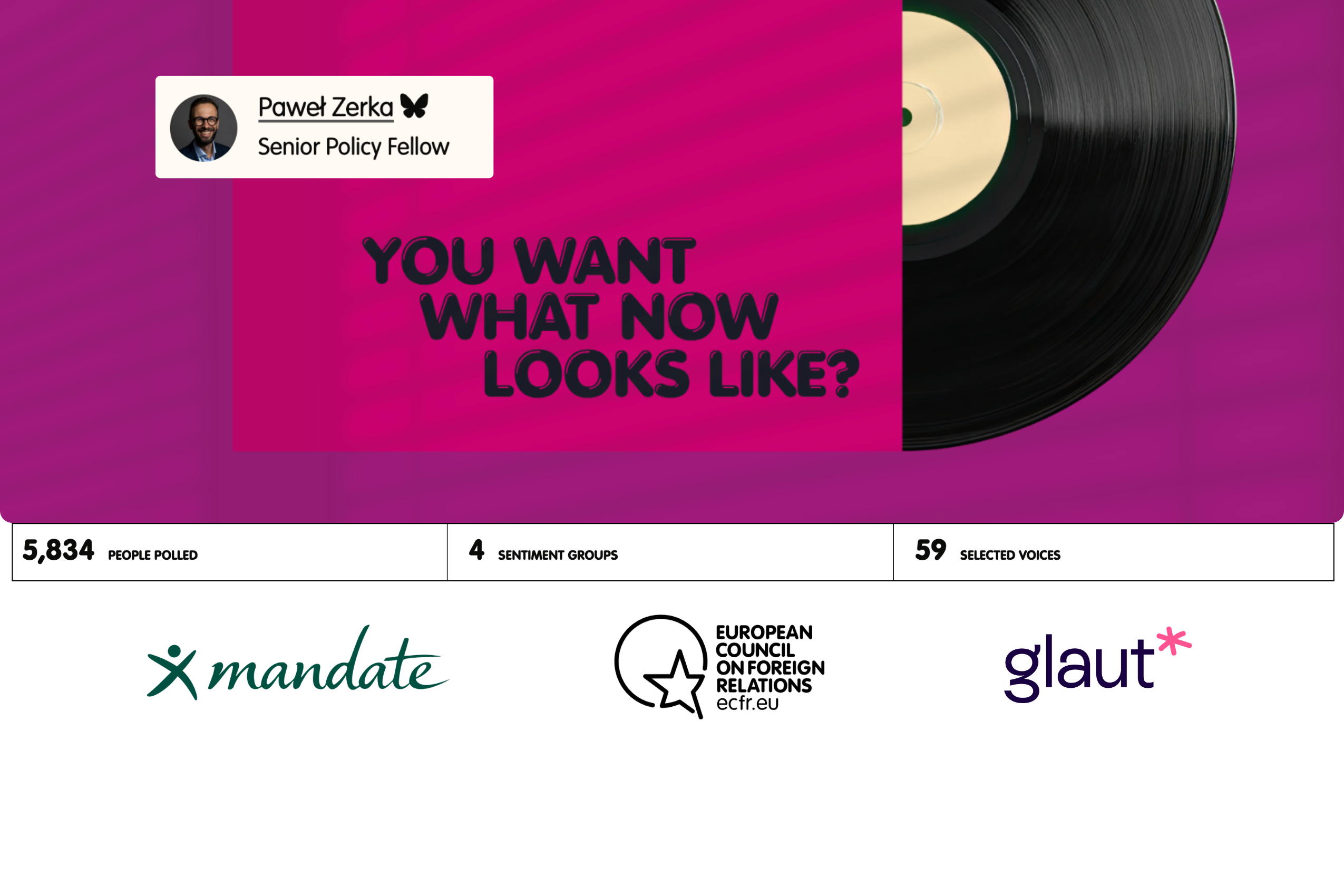
ECFR's Future Nostalgia study is a clear working example. Mandate Research collected 5,834 open-ended interviews across six countries using Glaut’s AI-moderated interviews platform, and coding those responses produced four attitude segments - Positive, Negative, Uncertain, and Disconnected - that explain how Europeans see the continent's future far better than age, country, or gender alone would.
Demographic segments and attitude segments are two different ways to understand groups of people.
This distinction is important because demographic segments give you a snapshot of who people are, while attitude segments reveal how they feel about the specific topic being studied. In the ECFR study, researchers combined both types of segments. They looked at the four attitude segments alongside demographic information to analyze patterns, such as discovering that the largest group with negative attitudes was found in France, Italy, and Germany, but not in the Netherlands. This approach helps to gain a deeper understanding of respondents' views beyond their basic demographic profiles.
The segments also highlight the study's key finding, the "imagination gap": a desire for a stronger Europe while simultaneously doubting its feasibility. This gap is present in about 75% of the Uncertain segment, around 50% of the Negative segment, and roughly a third of the Disconnected segment, leading to an overall rate of about 50% across the European public (lower, at approximately a third, in Poland). This pattern isn't apparent from demographics alone; it becomes clear only when respondents are categorized based on their actual responses.
The public methodology set out by ECFR shows that the four segments were produced by thematically coding the open-ended responses with the help of AI, although it does not publish the specific statistical technique used to turn those codes into segments. The overall structure of the process, as is typically carried out in qualitative-to-segment research, is as follows:
If you're carrying out a segmentation of this kind, it's a good idea to check with your research partner precisely what coding framework and grouping method they employ — the validity of the segments depends entirely on the process by which they were produced.
A valid objection to any segmentation that has been coded by AI is that the four labels assigned to open-ended answers are merely noise disguised as a structured format; a segmentation can only be considered defensible in so far as it is able to predict behaviour on questions for which it was not originally designed.
The ECFR study meets that criterion. For example, the Uncertain segment was not merely characterised by ambiguous language – it also ended up using the news media in a way similar to the Positive segment and showed considerably less confidence in the future of Europe, a pattern which appears consistently and not just as a random coincidence. The segments should also be valid when examined demographically and geographically: the fact that the Negative segment is the largest group in France, Italy and Germany but not in the Netherlands is the type of country-level variation that a reasonable segmentation should yield, rather than the uniform, undifferentiated division you would expect from random noise.
You should use attitude segmentation whenever you want to find out how people feel or what they think about something and that feeling cannot be easily linked to who they are—for example, their opinion of an institution, their desire for a policy, or their trust in an outcome. On the other hand, demographic segmentation is sufficient when the result directly relates to a characteristic such as whether a product is eligible, how frequently it is used, or purchasing behaviour associated with income or age.
The two are not a matter of choosing one or the other; instead, the ECFR study first used demographic quotas and weighting to ensure that the sample was representative and then added attitude segmentation to account for the variations that could not have been explained by demographics alone.
Collect, analyze, and report research from any source with more depth, speed, and control.
Schedule a free demo