Can AI-moderated interviews match human interviewers in eliciting disclosure and engagement?
As AI-moderated interviews become more common in research, a key question keeps arising: can an AI interviewer truly perform as well as a human moderator in terms of disclosure, comfort, and data quality?
A recent experimental study by Professor Billy Sung and Dr. Patrick Duong at Curtin Universityprovides one of the most thorough answers to date. Instead of relying solely on self-reported opinions, the study combines biometric data, self-reported experiences, and a controlled interview design to directly compare AI-moderated and human-led interviews.
Here’s what the research aimed to examine, its findings, and why it matters to researchers.
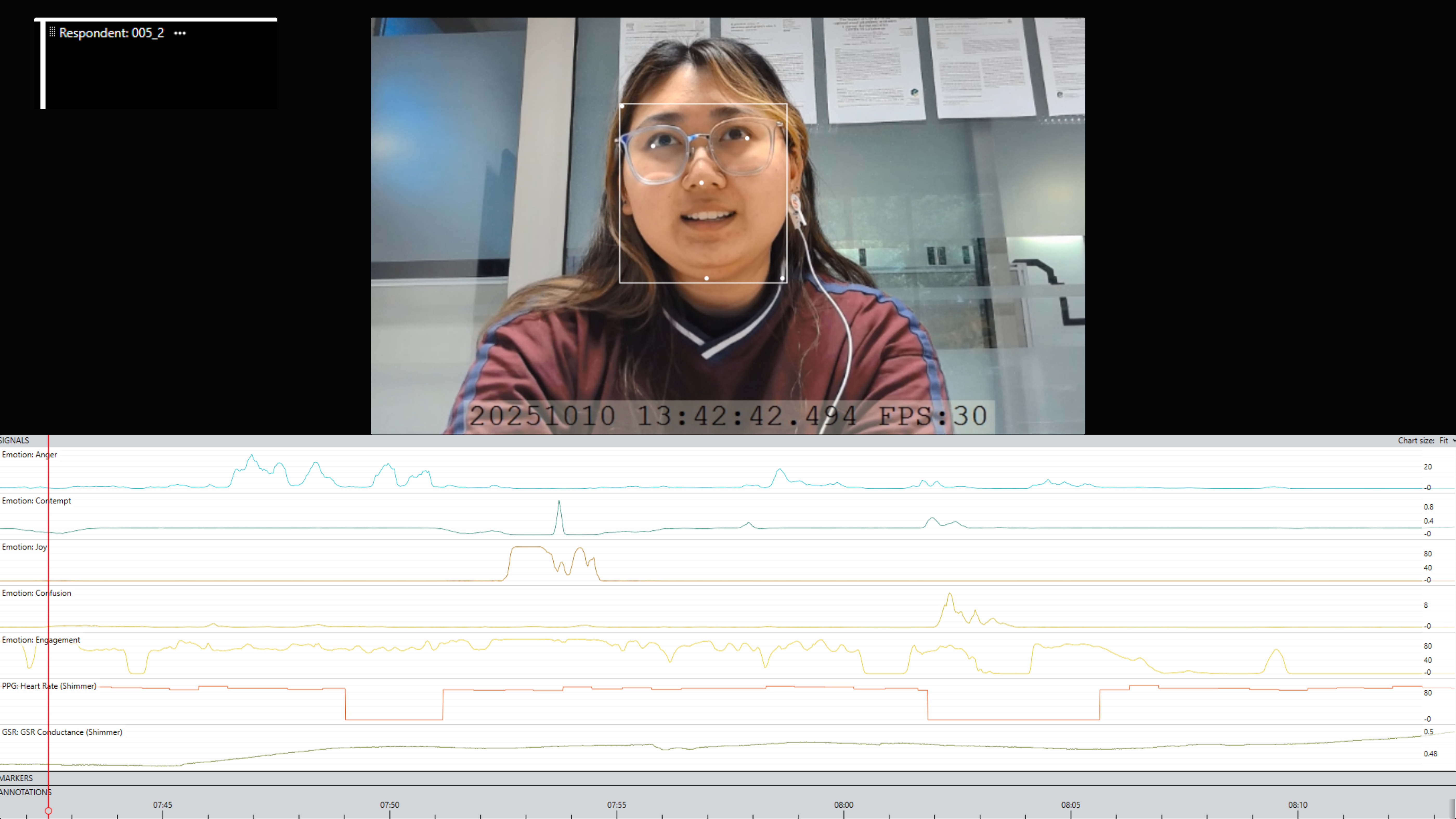
Image 1. Snapshot from a real recorded interview using biometrics.
The research question
The aim of the study was not to demonstrate that AI is “better” than humans.
It asked a more precise question: Can AI interviewers elicit disclosure and meaningful responses at a level comparable to human interviewers, without increasing discomfort or stress?
This distinction is important. In research, emotional warmth and rapport matter, but disclosure, trust, and data quality are what ultimately impact the value of insights.
Study design: keeping the comparison fair
The research team carried out a randomized controlled experiment where the only variable was interviewer type.
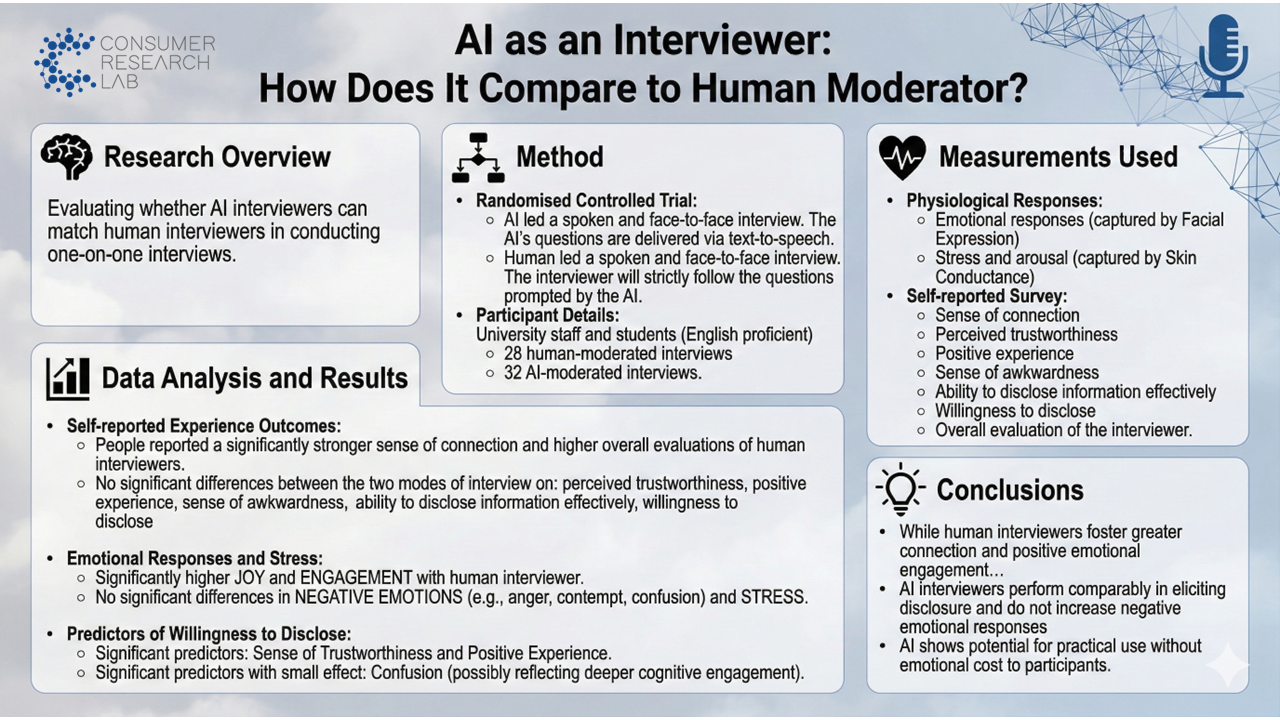
Participants: 60 English-speaking university students and staff
Topic: perceptions of fast fashion and how people justify their behaviour
Format: one-on-one, face-to-face interviews lasting around 16 minutes
Participants were randomly assigned to one of two conditions:
AI interviewer: questions were delivered via text-to-speech. The AI generated dynamic follow-ups based on each answer.
Human interviewer: a trained human moderator conducted the interview but followed the exact same AI-generated script and follow-ups.
This setup ensured that:
the content, order, and probing logic were identical
only the interviewer identity differed
Watch Dr. Patrick Duong explain the study
Tune in to Dr. Patrick Duong as he explains the study, making it easier and more engaging to understand.
What the researchers measured
The study went beyond traditional post-interview surveys.
Self-reported experienceParticipants rated:
sense of connection
trustworthiness
comfort and awkwardness
willingness to disclose
ability to answer effectively
overall evaluation of the interviewer
Emotional and physiological responsesDuring the interview, researchers captured:
skin conductance as a measure of stress and arousal
This combination enabled the team to see how respondents responded in real time, not just what they said.
Key findings
Humans create stronger emotional connection - Participants reported a higher sense of connection with human interviewers, and biometric data confirmed this:
more facial expressions associated with joy
higher engagement as measured by heart rate
This confirms what many researchers already know: humans are better at generating emotional warmth and rapport.
AI matches humans on disclosure and trust - Where the results become more interesting is on the metrics that directly affect data quality. The study found no significant differences between AI and human interviewers on:
willingness to disclose personal information
perceived trustworthiness
comfort and awkwardness
ability to answer questions effectively
overall positive experience
In other words, participants were just as willing to open up to an AI interviewer as to a human one.
AI does not increase stress or discomfort - Biometric data showed no increase in:
stress
confusion
negative emotional responses
Even though AI felt less “human,” it did not impose an emotional toll on participants. This is an important practical reassurance for researchers considering AI moderation at scale.
What actually drives disclosure
To understand why disclosure levels were similar, the researchers performed a regression analysis on all measured variables.
Two factors clearly predicted willingness to disclose:
trustworthiness
positive interview experience
Rapport and emotional connection, while important, were not the primary factors.
Since trust and experience ratings showed no significant difference between AI and human interviewers, disclosure outcomes stayed comparable. This is a key insight: for many research settings, emotional warmth is not necessary for honest, detailed answers.
What this means for researchers
The findings suggest a more nuanced way to think about interviewer choice.
Use AI interviewers when:
scale and consistency matter
standardisation is important
the goal is disclosure, explanation, and reasoning
budgets or timelines make large numbers of interviews necessary
AI interviewers can deliver comparable disclosure without introducing stress or discomfort.
Use human interviewers when:
emotional connection is central to the research goal
rapport itself is part of the insight
the topic requires deep relational sensitivity
Consider hybrid designs
One practical model is:
AI-moderated interviews for large-scale data collection
human-led interviews for smaller, emotionally intensive deep dives
This balances efficiency with interpretive richness.
Why this study matters
This Curtin University research is one of the first to combine:
controlled interview design
biometric measurement
psychological and experiential metrics
Its conclusion is not that AI replaces human interviewers.
It demonstrates that AI interviewers can consistently match humans in disclosure and comfort, even if they do not yet replicate human emotional presence. For research teams, this shifts AI-moderated interviews from a risky experiment to a methodologically sound option for many real-world studies.
If you are interested in the full methodology, biometric setup, and statistical analysis, read the full paper from Curtin University.